

From the Memoirs of Justus Alonzo Call: 1880. Book One in the Justus Alonzo Call series.
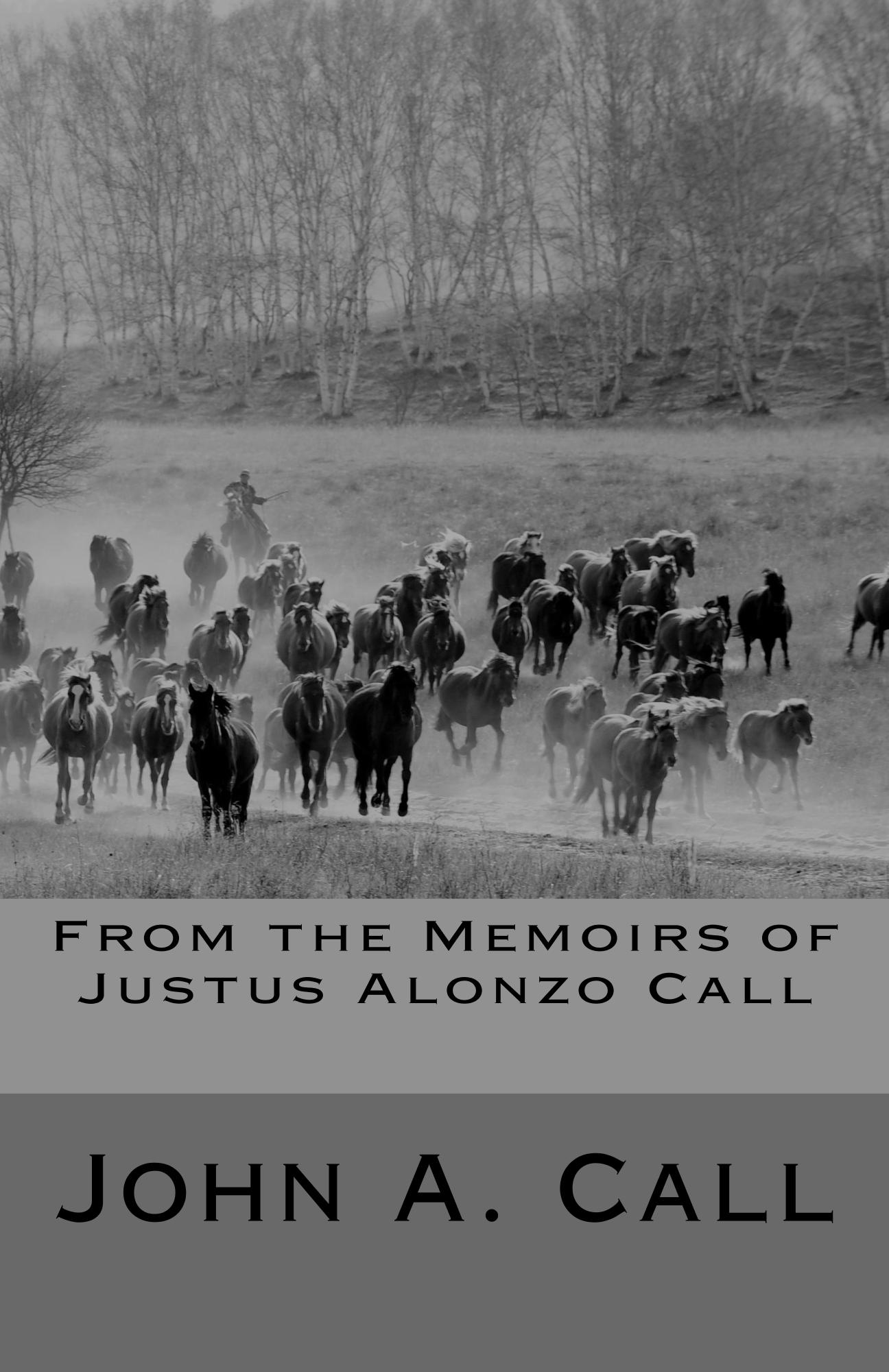
Justus Alonzo Call (1856-1940) was a freighter on the Santa Fe trail, a mustanger in Texas, an Indian fighter in the southwest, a cattleman in the Cherokee Outlet, and a criminal defense attorney in Oklahoma. Before his death he wrote his memoirs detailing his account of everyday life in the violent west of the 1880s through the first few decades of the twentieth century. This first volume introduces Justus Call and describes those early years of cowboy life in the Indian Territory, a country now known as Oklahoma.






Excerpt
CHAPTER 1
We camped out upon the plains on the head of the Cimarron,
Along came a dudish fellow and stopped to auger some,
Such an educated fellow we’d seldom ever heard,
He astonished all the natives with his jaw-breaking words.
--Old Zebra Dun (before 1890)
Tuesday Afternoon, Late March 1880
Wichita, Kansas
BLACK SMOKE CURLING lazily from its stack, the fifty-nine-foot-long American Standard locomotive, recognizable by its pony wheels just back of the cow catcher and its four driving wheels under the boiler, waited on the track. It stood, slowly chugging, like a huge draft horse impassively swatting flies. To the right of the big engine, on another siding, sat a line of dirty red-colored boxcars. Next to them squatted Charles Marsh’s coal dispensary.
Suddenly, the locomotive’s whistle blew a long shrill blast, sending a plume of white vapor heavenward. At the sound, a flock of crows exploded into the afternoon sky, black blobs against the amorphous gray clouds. They had been feeding by the side of the tracks near the caboose on some rotting carrion left by a pack of dogs. Standing nearby, the conductor, a small dapper man with a carefully pomaded mustache, looked down into his hand, checked his big Hamilton and then looked back up, south, toward the front of the train. He watched as the brakemen ran along the tops of the cars, stopping every now and then, to loosen the wheel-locks. Finally, after a few minutes, each of the brakemen leaned out from one of the eight cars and waved the okay. Taking hold of the lantern the conductor raised it up once, twice, then three times, signaling the engineer the all clear.
Almost immediately, accompanied by the squeal of metal wheels on rails and the clanging of couplings, the train jerked forward; then, just as abruptly, wrenched to a stop as the inertia of the cars and caboose fought against the might of the big Baldwin made steam engine. A fraction of a second later, two more loud whistle blasts sounded as the engineer let it be known that the 5:10 for Wellington was departing.
At the sound and movement of the train, the blond haired man, sitting toward the rear of the one and only passenger car, looked up from the day old newspaper he had been reading. A copy of the Wichita Eagle the news butch had discarded. The man looked out the soot smeared window as clouds of opaque vapor suddenly came boiling up from the tracks blocking his view of the stone depot. The train cars jerked forward once more as, again, the locomotive’s four drive wheels spun, driven by the steam powered pistons, fighting to gain purchase on the iron rails. This time the rearward yank was less forceful and the train began to gain forward momentum.
Excerpt
CHAPTER 1
THE OAK HAD been massive. Now, like an immense skeleton, it stood in a cleared area near the middle of the small hollow. The lightning bolt that’d killed it some years ago had caused a fire, which, even now, left a small open space. Only brush, mainly fireweed and tanglefoot, had grown back in the flinty soil. In the dead tree's top, at the very pinnacle, a large, one-eyed raven sat, waiting.
Suddenly a flicker of movement caught the bird's attention. Turning its head, the raven focused its gaze toward the forest’s edge, its ugly yellow beak silently opening, then closing. Slowly, in the distance, just below the crown of the opposite hill, almost hidden in the darkness of the forest, a rider emerged.
The man halted his animal with just a touch of rein. The trailing pack mule noting the lack of forward movement also stopped but stayed as far away from the dkaco's rear hoofs as its lead line allowed. As the rider studied the small vale below he leaned forward in his saddle and absentmindedly stroked the long slender neck of his animal, rubbing his hand along its thick black mane. The animal arched its neck against the rider's hand and sucked its bit. Both man and animal sniffed the air and studied the forest before them. After a while the man reached behind his saddle and opened a tanned hide saddlebag and took out a small leather cylinder. Uncapping the cylinder, he pulled out the copper colored metal tube that was inside, and then extending it, placed it to his right eye and once again slowly, carefully, searched the sky and then the forest.
"No signs." The man said softly as if to himself. "How about you?"
The animal shook its head and blew through its nose making a snorting sound. Then it stamped its right hoof. At the sound, the young mule looked up from its grazing and eyed the mount and its rider warily.
"Right then. We'll bed down there tonight." So saying the man returned the metal tube to its leather container and put the latter back into the saddlebag. "Maybe we'll have a small fire." Then following the touch of rein the animal and its rider slowly made their way down the tree filled slope toward the cleared space near the center of the hollow.
The death bird watched as the rider and his animals approached. The raven had seen his kind before. Often the “battle crow”, the Morrigan, had fed upon the flesh of those slain by such as the rider. In fact, it had fed upon the dead and dying flesh of the warriors themselves when they in turn had been killed; their bodies hacked and slashed to pieces by their enemies. The black one tilted its head, its blood red eye glowing with an intense, unnatural light.
On his head the man wore a metal helmet the color of proofed steel. The helmet was a ridged bowl with an articulated neck and cheek guard. It had a metal bill through which ran another stout piece of metal, a nasal that protected the man's nose and eyes from slashing cuts to the face. Around his body the man wore a brigandine made of small proofed plates of steel riveted together for flexibility and covered by fabric and leather. The brigandine was further reinforced with two large placcates of steel, one on each breast. On the right placcate, if one looked closely enough, could be discerned, inscribed into the steel, two sigillum, the first circular and silver, the other square and gold, in color. The first proclaimed, to those with wit to understand, the man a Warrior Brother of the Order of 7 God’s Shield and the gold, his rank, of Knight Commander. In the darkening gloom a faint glow of power emanated from both.
Banded maille made of a mixture of leather and metal covered his arms and thighs, to protect his shoulders he wore cunningly fashioned steel pauldrons. His feet were encased in dark brown riding boots that sported the high heels of the eastern plains' barbarians. His hands were in leather gloves. Across his back, in its scabbard, was slung a large curved sword. Hanging from his saddle at his left knee was a lacquered bow case in which rested a small but powerful horseman's bow made of wood, horn, and steel. At his right knee hung a quiver of arrows neatly arranged in different compartments depending upon the type of arrowhead that was attached to the shaft. At his left another, smaller quiver, filled with alchemikal arrows.
Once at the clearing the man slid off his mount and stretched. A grimace crossed his face as pain shot through his right shoulder. The wound was slow to heal. Untying his helmet, he pulled it off and ran a hand through his short spiky white hair. Then he began to unpack the mule after first hobbling the creature and attaching the lead line to a metal stake he pounded into the ground. With its burden removed the young mule promptly dropped to its knees and then rolled onto its back in the dry grass, luxuriating in the feel of rubbing its sore back on the ground. After a bit it stood and began to graze.
In the meantime, the man had unsaddled his mount and carefully rubbed the animal's back, sides, and legs with handfuls of dried grass. He followed this with a brisk currying with a small metal brush. Except for its tail and mane, the animal's hide was almost hairless. Its skin had a shimmering black-gray appearance and if one looked closely one could see it was made up of very small scales. Its appearance reminded the man of the inside of his brigandine and, in effect, it had a similar purpose-- protection.
Moving to the animal's head the man gently stroked its muzzle and fed it a strip of jerky, and then another.
"Sorry no fresh meat tonight, maybe tomorrow." The man said softly looking into his mount's slitted cat's eyes. The animal snorted and stamped a rear hoof as its sharp teeth made quick work of the shoe leather tough dried meat. "And don't eat the mule unless you want to carry me and the pack tomorrow." The man smiled at the beast’s sudden expression of disgust.
The man looked around in the dim light of the setting sun. All that he owned lay in a few fitted leather and wooden cases spread upon the ground before him—his books, his learned paraphernalia and materials--empirikal, alchemikal, and metaphysikal, his battle armor and shield, a few clothes and his traveling gear. Not much, most would say, for a man who had lived for close to forty-seven years. But then he supposed it was more than that with which he'd been born.
The man had been a foundling child whose pilgrim parents had been slain in the desert on their way to the holy city; or so said the warrior monks who’d raised him. His whole life had been in the service of the Order, Ordo Divinae Scutum—God’s Shield the pilgrims named them.
As a child and youth, he had worked and studied twelve, fourteen hours a day. He had done all that had been asked of him, even more, mucking out the stables, caring for the mounts and their equipment, working in the armory cleaning the maille shirts by placing them in the huge casks of scouring sand and vinegar, turning the casks for hour after hour, sweating in the kitchens, serving at the tables. Later, as he grew older, he’d also read and studied in the great library, practiced new learned alchemikal and magikal knowledge in the cluttered, foul smelling cubicles 9 of the mysterium, atop the north tower and exercised with all manner of arms in the weapons halls.
It had been a hard life with no mother or father, just the warrior monks as master and teacher and later, a few, as friends. But he had been fed and clothed and taught skills. Skills of life and death; abilities both mundane and arcane. He had set his first broken bone at age thirteen, performed his first restoration spell a day later, fought and killed his first infidel Sarceren on caravan patrol at the age of fifteen, and, at the age of eighteen, had become one of the One Thousand, an Ordained Knight of the Order.
He had designed, constructed, and fought his first siege engines at the battle of Yrodil five years later. He had become a Knight Captain at the age of twenty-seven and one of the Order’s youngest Siege Masters at the age of thirty-three. Then, one night, a decade ago, he’d been taken blind folded from his sleeping chambers, led into the Grand Marshall’s personal chapel and inducted into the agents in rebus; and from that moment on had become a member of the Order’s shadowy clandestine service. And, for the last ten years, as one of the Order’s doer of things, he had traveled many a far and perilous league, as far east as the Great Wall of the Hiung-nu, as far north as the mountains of Hamiya, and as far south as the sweltering jungles of Yndie, ostensibly acting as one of the Order’s Kataskopos--a Greek word usually understood as referring to a diplomat, but which also could be translated as--a spy—and, as an agent in rebus, was, in fact, the more accurate description of his duties.
But, for all his dangerous wanderings, it had been within a hundred leagues of Krak des Aigles, Fortress of the Eagles, one of the Order’s most famous fortified monasteries, and his home for as long as he could remember, that he had almost died, wounded by a Hashasian battle-mage’s arrow--and one tainted with a surprisingly strong daemon’s curse. If it hadn’t been for the Grand Marshall’s personal healer and knife, Brother Stefan, he would have died. As simple as that.
He paused. Then looked down at his scarred and calloused hands. But—maybe--leaving this earthly moil would have been a kindness, he thought to himself bleakly. He closed his eyes, struggling to still the nameless ache within him. He hadn’t always been plagued by such dark reflections, he thought morosely. Once, long before he’d become a Kataskopos and a doer of things, when he’d been a simple ordained knight, there’d been Tamla, his Shield Sister. Then, his life had had color and joy and, yes, even happiness, instead of the hollow steel grey austerity he now lived within.
What would have happened had she lived? He asked himself silently. So many turnings, so many paths forever lost. He looked again at the lowering sun. You are getting old, he chided himself, laying his sheathed sword across his saddle. What would Brother Nichos say--if he knew? Unbidden a fragment of memory blossomed into his mind.
*
“What are you doing, Brother?” The boy asked from where he sat on the stone floor by the fire grate and the glowing coals, grilling the bread and cheese.
“I’m writing in my journal.” Answered the aged monk from the wooden table.
“What about?”
The robed, hunchbacked man looked up from his stained and yellowed parchments and over to the small boy dressed in little more than rags, a look of fondness passing over his scarred visage. “Can you keep a secret, Dai?”
The boy’s eyes widened in suspense. “To the death, Brother Nichos!” The small urchin quickly responded bringing his right hand to his chest saluting as if he were a belted knight and almost dumping the cheese toast into the fire as he did so.
The man chuckled. “Well, let’s hope it doesn’t come to that.” The man paused thinking. Then nodding to himself as if deciding 11 upon something important, that hopefully he wouldn’t later regret, he sat down his quill and leaned toward the fire where sat the boy.
“Have you ever heard of the lapis philosophorum?” The man asked in a low voice, glancing toward the chamber’s closed wooden door. “Perhaps in your studies in the mysterium?”
The boy screwed up his face in thought, then shook his head no.
“There are actually many names for it—calculus albus, lapis occultus, lapis benedictis, draco elixir, filius ignis, rex regum, sal metallorum, ventus hermetic—to name but a few.” The man paused. “Or perhaps you’ve heard of it as named—the philosopher’s stone?” The man waited expectantly.
Again, the boy shook his head no.
“Well, that is what I’m writing about…” The elderly warrior monk stopped and leaned back on his stool. “Many, nay most I think, of my brother alchemists believe that the lapis is solely to be used to turn base metals into gold. But they are wrong, so very wrong!” The man’s voice became more forceful as he turned back to his manuscripts. “The lapis is much, much more than that. In fact, I believe the real purpose of the lapis is to rejuvenate life, possibly even to attain immortality.” The old man paused. “Come stand beside me.” He waved the boy to join him.
“Now, see here.” The monk pointed. The boy looked down at several sheets of vellum which were covered in the squiggly writing of the infidel. “This is a letter from my colleague, Jabir ibn Hayyan. I’ve just received and decoded it. It’s taken months to reach me by caravan from Persia.”
The boy looked up at the monk in surprise. Even though a child he well understood the war between the kingdoms of the east and west; and, in fact, was training to be a holy warrior in that very same conflict, and learning that a warrior monk of the Order was in contact with an enemy infidel and actually called him ‘colleague’ was quite a surprise.
“He writes that he has found a copy of the Tabula Smaragdina, the Emerald Tablet!” Noting the boy’s puzzled frown, the monk continued. “The Tabula is purported to be the work of Hermes Trismegistus, the legendary Gyptian scholar from before the ancient times. The codex reveals the secret of a primordial substance, what ibn Hayyan calls in his letter—aliksr.” The monk pointed to a curious squiggle on the page in front of him. “Ibn Hayyan writes me that al-iksr may be a red powder made from the lapis and confirms that the Tabula states that it can change the very nature of other substances.
He says that the copy he’s found appears to be genuine and that he’s in the process of transcribing it and will share with me what he learns.” The monk leaned over, took a piece of cheese toast from a wooden platter, and bit into it. Then, chewing thoughtfully, he looked at the boy full in the face.
“I keep all my documents about the lapis in that iron chest, over there.” He pointed to the far wall. “Crucial notes, drawings, deductions, references, conclusions, the distillation, as it were, of all my study, I write in this codex.” The warrior monk paused, then smiled, and ruffled the boy’s shaggy head. “Someday, maybe I’ll want you to help me in my work. My special work. But it must be our secret. Agreed?”
The boy smiled proudly at the old monk’s request, nodded gravely, then reached to grab a piece of toast--.
*
Later, standing beneath the dead oak the man drew his sword from its scabbard and began the evening drill, the dance of the hundred cuts, the very first one-man fight form he had learned when he was a child of six, when he’d first heard the old monk’s secret. As the sword whistled in the air, just a blur, the man began to sweat. Heedless of the pain in his right shoulder he pushed himself to his limits. Fighting his imaginary foe, he gripped the wire bound hilt in a two-handed grip and struck hard again and again. Near an hour passed as he whirled and stamped, thrust and parried.
The skill and precision were still there but his speed and strength were not as they used to be. Would they ever return? Probably not, he admitted ruefully to himself, wiping sweat off his brow. Many would say he was lucky to have lived this long and he wasn’t getting any younger, was he. In a few years he’d be fifty—an old man by most reckoning.
He studied the blade of his sword, noting the watery tracings running up and down, where the steel had been folded over and over onto itself when it had been forged until the curved blade was made up of thousands and thousands of layers. The edge was hard and sharp, the back softer. The guard was oval in shape and intricately carved. The two-handed hilt was leather covered wood which was then bound in silver and steel wire to ensure a sure grip. Finding no flaw, the man carefully wiped the blade with a piece of oiled cloth he kept especially for the task. Suddenly, it struck him that many would say that he and his sword were much alike: pounded, hardened, sharpened, fashioned into a cold and deadly instrument. He shook his head regretfully at the thought; then deftly sheathed his weapon in its scabbard and bent to lay the weapon beside his pack.
It was now near dark and his breath was frosting in the cold air. The man moved to where he had unpacked the mule and from the leather covered bundles pulled out a thick woolen traveling cloak, a towel, and a small wooden chest. He quickly stripped and reaching into the chest drew out a thick blue-glass bottle filled with a whitish colored powder. After shaking some of the powder onto the towel he proceeded to dry wash himself, rubbing the towel vigorously over his body. Then he dressed putting on the cloak, leaving the cloak’s hood to flop against his back.
The man then pulled out his bedroll, which was made of a waterproof, heavily waxed canvas shell in which resided thick woolen blankets. Spreading his bedroll out on the ground he sat down and using his ordinary knife cleared a small area of dried grass and weeds digging until he’d made a small trough in the damp earth. Then he stood and gathered some of the dead wood that had fallen off the oak, some twigs the size of his thumb and a few limbs about as big around as his wrist, these he later split. Returning to his seat at the head of his bedroll he skillfully built a small pyramid of dried twigs over a bit of charred cloth he had set in the trough. Using a flint and steel he ignited the blackened cloth and began his fire.
Gradually with the experience of over thirty years of campaigning the warrior built his cooking fire. The homely chore helped calm him. Tonight he’d make a minced stew, just like old battle-scarred Brother Nichos had taught him so many years ago, boiling the dried meat with the dried fruit and vegetables in a small kettle, then adding the spices and flavorings and, finally, pouring the whole mixture over the flat bread that he cooked in the fire’s ashes. He’d leave half in the covered kettle for breakfast tomorrow at daybreak.
Thinking again of his old mentor he reached inside his pack to touch the leather-bound codex the elderly monk had left him when he’d passed. Feeling its presence, the man nodded to himself, reassured, and let his muscles relax.
Later in the full dark of night the man lay in his bedroll, the small cooking fire a glow of embers a few inches away. No stars shined in the cold sky for the overcast remained. In his mind’s eye he studied the vellum maps that lay curled in their leather cylinder attached to his saddle horn. Tomorrow should bring him back to the Great Road that started at the inner sea and wound its way, so his geographies assured, west to the ocean. Be that as it may, he was many months, and a thousand or more leagues, from the desert plains and mountains of the east where he’d spent most of his life. The next kingdom on the road was Norlӧnd, what several hundred years ago had been known as Neustria, “the New Western Lands”, and before that, during the times of the ancient Romanii, had been called Gallia Lugdunensis, though few but scholars knew, or cared, about such things nowadays. No matter, he thought to himself his eyes closing with fatigue, enough planning for now, time to rest. Cradling his sword against his body like a lover, the man turned on his side and slept.
*
She was young for one of her kind, only a few millennia in fact, a young rainfeather pearl her mother called her. She was so young she could not even remember the Fall, when her tribe and the others of her ilk had rebelled, led by the Dark Lord against the Great One and had been thrown down, forevermore, into Oblivion for their transgressions. Rightfully so, of course, she admitted to herself, automatically making a ritual obeisance to the Most Holy One, bowing her head, briefly, in prayer.
After a moment, she paused and frowned. She’d never understood that whole affair; and the elders would never discuss it. She mentally shrugged away that old, unsolved conundrum and took up, once again, thinking about the now. As a ViVac, a daemon of the Fade, her plane of existence was far removed from the cold, dank sod and barren trees of the mortal world that presently surrounded her. But through a set of fortuitous events, fortuitous for her that is, but not so for the black-hearted sorcerer who had so rashly summoned her, she found herself free, for a while at least, to wander this particular corporeal world.
Such worlds she had heard of, of course. But she and her kind rarely, if ever, personally experienced such places. And she intended to do just that, experience this existence to the fullest; and maybe, no probably, since it was her nature, in fact the very purpose of her kind, she would punish those sinners whose path she crossed!
The young daemon smiled malevolently as she lay upon the ground, casually switching her long-pointed tail back and forth, as she watched the man and his beasts in the small vale below. Would his soul be as dark and deserving of being reaped as the woman she had harvested days a go—the one who had drowned her children just a fortnight past? Waiting, she licked her lips with her narrow cleft tongue exposing, as she did so, her sharp pointed teeth.
*
Dawn was about a quarter glass away when the man was awakened by the prodding of his animal. As he opened his eyes a feeling of anxious unease filled his mind—a threat, nearby! The man took the dkaco’s warning seriously. Men did not know much about dkacos, in fact most men did not even know of their existence, but those that did knew enough to understand that the dkaco were not like other beings of the natural world. The man had lived with this particular creature for most of his life, he had no doubts about his animal’s warning, he quickly dressed and armed himself; then, standing shoulder to shoulder with his animal, both waited for the dawn…and what might come.
The night slowly gave way to the cold, watery light of predawn. The man looked north, scanning the forested hills the dkaco watched so closely. As the first rays of morning light broke over the eastern crests, the man thought he saw a movement at the tree line. Quickly taking the brass optikal from its case he put it to his eye. There! For a moment he thought he’d seen someone, or something, a form, like a young woman perhaps, or was it an old hag? In the distance, he heard the shrill calls of crows.
Suddenly, his eye blurred with a sharp pain, and the man quickly shifted the optikal to his left hand while he rubbed his eye with his right. After a moment, he lifted the optikal again to his eye and scanned the horizon, left and right, up and down. Nothing! Puzzled he glanced at the dkaco. The beast snorted and shook its head angrily while stomping its right forefoot, then returned the man’s glance. The man could sense the animal’s change in mood. Whatever had disturbed it was no longer there; or, leastwise, now, it was no longer close enough for the dkaco to worry about.